
Product data that sells
Product data enrichment: for fashion and apparel
Smart Product Tags is a mixNmatch module that reads every product like a stylist and fills in the attributes your shop search, your filters and AI shopping assistants need: style, occasion, fit, material, design details, season and colour family.
AI product data enrichment, taxonomy mapping and AI-ready texts: the basis for every other module, and for being understood by ChatGPT, Gemini and others.
In and out
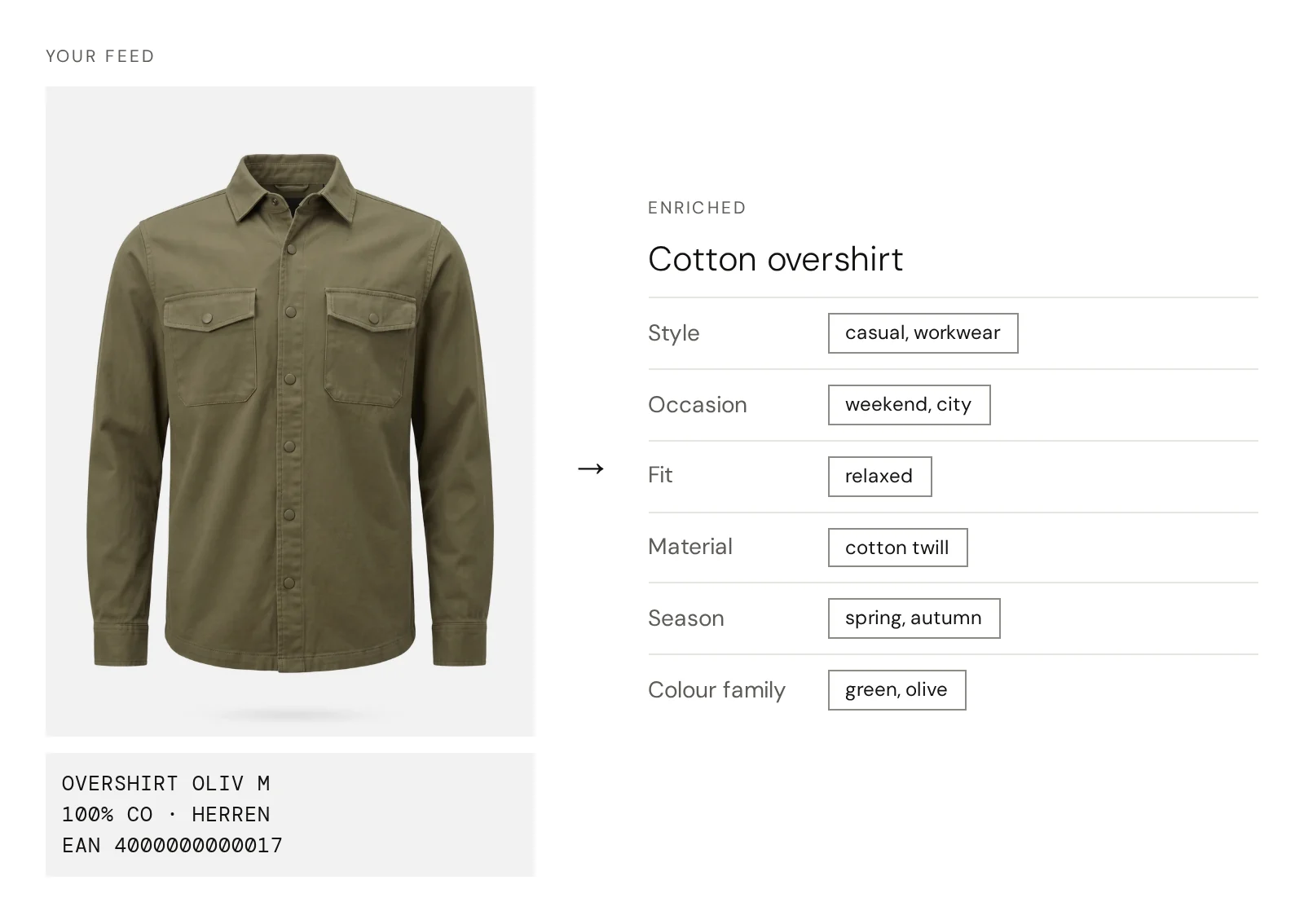
What your shop already has goes in. What mixNmatch adds comes out, marked in yellow.
InProduct feed
OVERSHIRT OLIV M
100% CO · HERREN
EAN 4000000000017
OutEnriched attributes
- Style
- Occasion
- Fit
- Material
- Season
- Colour family
What are Smart Product Tags?
Smart Product Tags is AI product data enrichment built for fashion.
Read more
It reads every product in your feed, title, description and image, and adds consistent attributes: style, occasion, fit, material, design details, season and colour family.
A feed row that only says “ladies blazer blk 38” becomes a tailored, business-classic blazer for the office and for dinner, in the black colour family. New products are enriched automatically, and every other mixNmatch module runs on this data.
Why does thin product data cost sales?
Most fashion catalogues are under-tagged: tags kept by hand, inconsistent across seasons, often in one language.
Read more
The shop search cannot match “elegant dress for a summer wedding” because no product carries the occasion, filters stop at size and colour, and AI shopping assistants such as ChatGPT or Gemini cannot understand a product well enough to recommend it.
Enriched data fixes the cause: once every product carries style, occasion and fit, search, Smart Filters, looks and personalisation all improve at once.
What is GEO for LLM visibility?
GEO, short for generative engine optimisation, prepares your product data so that AI shopping assistants can read, understand and recommend your products: categories mapped to a standard taxonomy, structured attributes and descriptions that say what a product is, for whom and for which occasion.
Read more
On Shopify this fills the category and metafield data of the standard product taxonomy. GEO improves your eligibility to be found; it does not buy rankings, which each AI channel controls itself.
Market benchmarks for styling and discovery overall, including first reports from in-house solutions of fashion flagships, point to up to three times more traffic from AI assistants.
How it works
It moves Findability Traffic from AI assistants
Also called: product tagging, attribute enrichment, feed enrichment, GEO
- 01
Connect your feed
A Google Merchant feed, an API or your Shopify catalogue, in whatever format you have.
- 02
Read like a stylist
AI reads the title, description and image of every product.
- 03
Attributes come back
Style, occasion, fit, material, details, season and colour family, mapped to a standard taxonomy.
- 04
Everything runs on it
Search, filters, looks and AI assistants read the new data. On Shopify it is written back as metafields.
Compared with
today
| mixNmatch | Tags kept by hand | Generic AI text tools | |
|---|---|---|---|
| Fashion attributes: style, occasion, fit | Yes | No | No |
| Reads the product image as well as the text | Yes | No | No |
| New products enriched automatically | Yes | No | No |
| Mapped to a standard taxonomy | Yes | No | No |
Three building blocks
Product data is the base. Looks and try-on build on it, personalisation on both. Start with the block you need.
-
01 · The base
Product data
Taxonomy and attributes from images and text: the base that search, filters, looks and AI assistants read.
- Better search and filters
- Visibility in AI assistants
-
02 · Builds on the base
Looks & try-on
Looks created automatically from your range, found in the shopper’s own words and tried on before buying.
- Cross-selling
- Basket value
- Conversion
-
03 · Builds on both
Personalisation
Styling for each customer, based on profile, likes and purchases, online, in CRM and in the store.
- Retention
- Repeat purchase
- Lifetime value
The modules
Every module is available through our REST API and in the Shopify app.
-
Smart Product Tags
01 · Product data enrichment & AI visibility
AI reads every product like a stylist and fills in style, occasion, fit, material, details, season and colour family. New products are enriched automatically.
-
Smart Filters
01 · Product data enrichment & AI visibility
Filters by style, occasion, fit or preference instead of only size and colour.
-
GEO for LLM Visibility
01 · Product data enrichment & AI visibility
Generative engine optimisation (GEO): taxonomy, attributes and texts that ChatGPT, Gemini and other AI assistants can read. This makes your products eligible to be found; we do not promise rankings.
-
AI Visibility Monitoring
01 · Product data enrichment & AI visibility
An ongoing view of how complete and AI-ready your catalogue is per category, and what to fix next.
Common questions
Which product data do you need, and what comes back?
Your product feed with images, title, description, category, colour, price and availability. Back come consistent attributes for style, occasion, fit, material, design details, season and colour family, a mapping to a standard taxonomy and product texts written for shoppers and AI assistants.
Does the enriched data flow back into our shop?
On Shopify, the attributes are written back as product data and metafields. With the REST API, you receive them for your shop system, PIM or search, in the format you need.
Can you guarantee that we will show up in ChatGPT or Gemini?
No, and nobody honestly can: each AI channel decides its own ranking. What we can do is make your product data complete and readable for them, which is the precondition for being recommended at all.
Who owns the enriched product data?
You do. You own your product data, your customer data and your content. We use your product data to deliver the service for your shop, and nothing brand-identifiable is shared with other clients. On Shopify, the enriched attributes are written back to your store.
Your catalogue,
styled
Tell us about your shop and your KPIs. We prepare your offer and a demo on your own product pages, ready within 1 day.